Stewart Brown · Historical research · Updated October 4, 2026
What changed since 2024?
Schools are placing new limits on technology they provide. A fair comparison asks what changed in the same place, for the same students—and whether the change has started.
This page keeps 2024 as the baseline and shows selected dated policies and directly documented changes. Personal-phone bans remain a separate policy wave. Screen caps, school-device restrictions, AI moratoria and approved-tool requirements are included here only when official evidence establishes the rule and its timing.
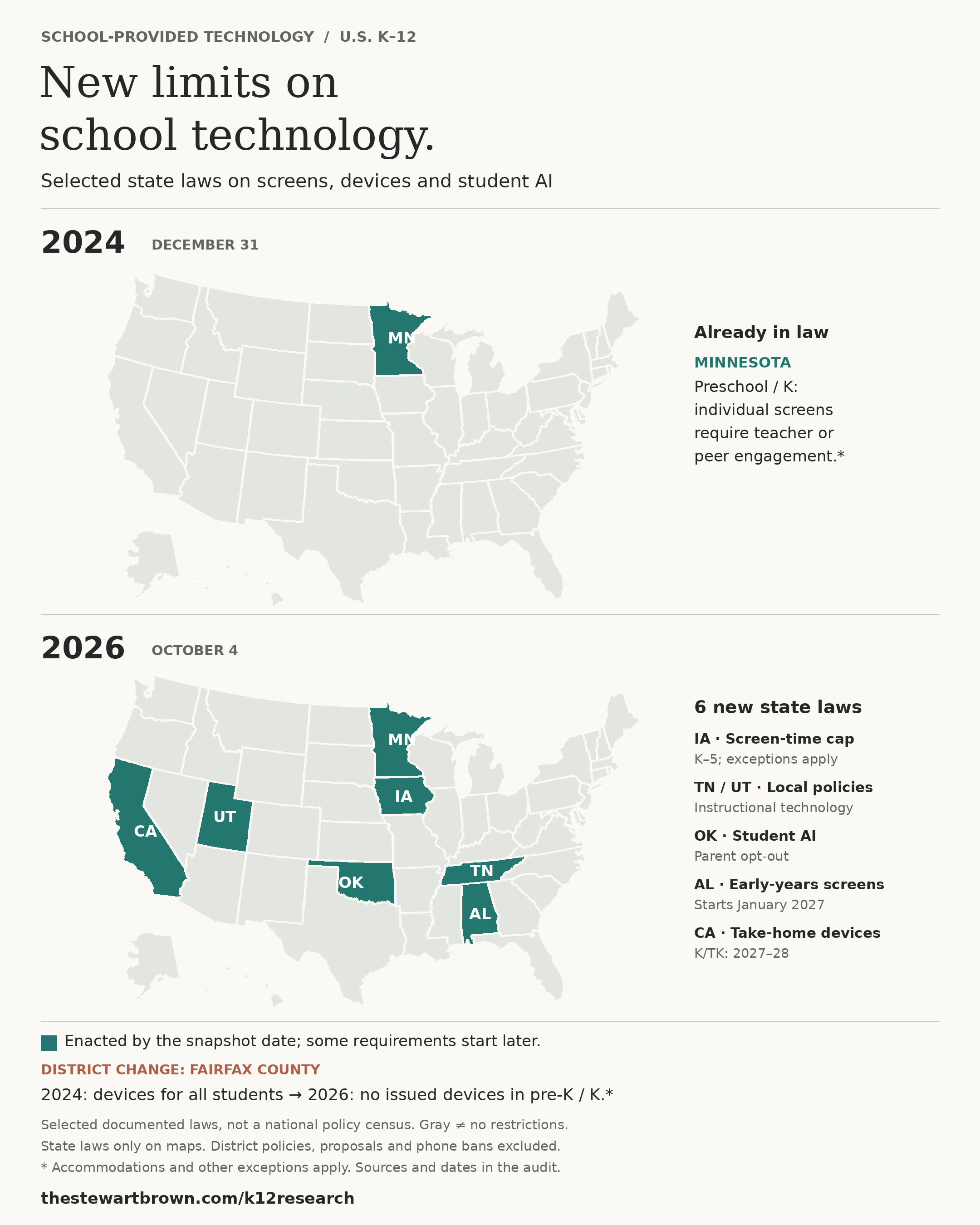
The same enacted-law definition at both dates. These selected instruments do not establish a national increase from one state to seven. District policies are compared separately below.
Two direct device comparisons, followed by two cases that explain why a simple count of “districts with restrictions” can mislead. These are documented cases, not a representative sample.
Direct comparison · K–2 device assignment
Seattle Public Schools
Before · 2024–25 school year
The district said every student would be assigned a school device. Its 2026 announcement confirms the preceding K–2 model assigned each child an individual iPad.
What this establishes: Verified change in device model; adoption and implementation must be counted separately.
Direct comparison · Preschool and kindergarten device issuance
Fairfax County Public Schools
Before · May 23, 2024 district board report
The district reported that all students had access to a 1:1 device, including 18,070 iPads in pre-K–2. This establishes district-wide access, not just one elementary school.
July 16, 2026 district board action prohibits FCPS-issued laptop/tablet use in pre-K and kindergarten, with disability and language-support exceptions.
What this establishes: Expansion into another policy dimension, not a district newly acquiring its first restriction. No claim that the earlier AI prohibition was newly adopted in 2026.
Context and qualification · Historical AI policy and new device rules
East Penn School District
Before · September–October 2024
District adoption of AI policy 815.1 is documented. The original student-access clauses remain incompletely recovered.
What this establishes: New device-policy announcement verified; first-ever restriction and prior elementary take-home practice not certified. Excluded from a numerical net-increase claim.
15verified adopted, enacted or announced actions after 2024
6 + 9state laws plus district policy packages
3active in-scope proposals, listed separately and not counted as policy changes
This register shows 17 selected packages, including documented baseline policies. It is not a claim that no other U.S. policy exists. LAUSD already had an age-based AI restriction in 2024, and four unresolved historical cases are named below. Future-effective actions are included as decisions, not current classroom implementation. The much larger 2024–26 personal-phone policy wave is tracked on the device-policy pages and is excluded from this school-provided-technology count.
Where the verified actions are documented
Verified enacted state law, including future dutiesNumber of verified district packages in that stateNo qualifying state enactment shown; absence not verified
District markers are state-level counts, not district boundaries. Select a state to filter the register. The two-date image above maps selected enacted state laws only. This interactive map additionally shows selected district packages; these are not a national district census.
These bills satisfy the same subject-matter rule as the verified register, but they have not passed. Their latest official status is shown as of October 4, 2026.
North Carolina · Proposed legislation
SB 948 · Screen Free Schools Act
Pending · Senate Appropriations/Base Budget
Screen timeSchool-issued devices
Would prohibit most K–5 classroom device use, limit daily device time in grades 6–12 and restrict individually assigned or take-home school devices by grade band.
Introduced
Apr 30, 2026
Status checked
May 4, 2026
Exceptions / limits
Includes special-education, medical, emergency, assessment and specified instructional exceptions; consult the filed bill for the full list.
Official bill page, status, summary and bill text.
Reviewed Oct 4, 2026
New York · Proposed legislation
S10685 / A11669 · FOCUS Act
Pending · Senate Rules
Screen timeSchool-issued devicesStudent AI
Would create grade-based limits on school-issued devices, prioritize non-digital instruction and restrict generative AI and distracting services on school devices.
Introduced
Aug 21, 2026
Status checked
Aug 21, 2026
Exceptions / limits
Preserves uses inherent to a learning objective, disability-related assistive technology and other specified instructional needs.
These are visible so an unresolved date or earlier version cannot disappear from the comparison. They are not counted as new actions or as confirmed absences.
Chicago Public Schools · IL
Recover the original 2024–25 AI guidance and effective date before coding a historical restriction event.
The current official hub confirms an earlier governance program, but it does not by itself establish the original student-access rule.
Filter all 17 policy packages in this release. Legal effective dates and school implementation are distinct from adoption or announcement dates. Pending proposals are kept in the separate watchlist above.
School-issued devicesStudent AIPre-K–elementary device and AI limits; secondary authorization
Ends FCPS-issued tablets and laptops in pre-K and kindergarten, makes student generative AI unavailable in elementary school and requires principal authorization for secondary use pending policy.
Comparison date
Jul 16, 2026 · Board adoption
Adoption / signing
Jul 16, 2026
Legal effective date
Not separately verified
School implementation
Board action applies beginning in fall 2026.
Funding / support
Dedicated funding was not verified in this review.
School-issued devicesTransitional kindergarten and kindergarten take-home devices
Prevents local education agencies from requiring TK and kindergarten students to take home school-issued electronic devices from 2027–28.
Comparison date
Sep 10, 2026 · Signed
Adoption / signing
Sep 10, 2026
Legal effective date
Not separately verified
School implementation
The take-home-device requirement starts in the 2027–28 school year, according to the Senate’s post-enactment summary. The separate legal effective day is not verified here.
Funding / support
Dedicated funding was not verified in the reviewed enactment summaries.
Dates: Use December 31, 2024 as the statutory baseline and October 4, 2026 as the cutoff. For device practice, dated 2024–25 school-year documents are more informative; their exact periods are shown, rather than backdating a 2025 document to December 2024.
Same universe: The search panel is all 50 states plus D.C. and the same purposive set of 35 districts for current and historical searches. It is not a ranked top-35 list or a district census. This page lists every verified in-scope package in the release and names unresolved historical cases.
Same rule: Count a material limit on instructional screen exposure, school-device assignment/take-home access, or student-facing generative AI. Exclude personal-phone-only laws, ordinary filtering, general privacy rules and academic-integrity expectations alone. Approved-tool access requirements can qualify; teacher permission alone does not establish a district ban.
Two measures: An adoption register counts new laws or policy packages. A stock comparison counts jurisdictions with a qualifying restriction at each date, subtracting reversals and expirations. This release contains a selected dated policy register, but it does not yet support a complete national stock comparison or growth percentage.
One package: Related grade bands, topics, preparatory resolutions and implementing rules are not separate enactments. LAUSD’s 2024 AI bulletin and its later screen/device package are different actions within the same district.
Status: Enacted, announced, effective, phased and recommended are not interchangeable. Seattle’s new device model starts in January 2027. Alabama and California also have later requirements. Utah’s detailed R277-334 grade restrictions remained proposed at the cutoff; the statute is counted once. Pending bills appear in their own watchlist and never increase the adopted-policy totals.
Unknown is not zero: Unrecovered historical policy text and unsuccessful searches do not establish absence. Chicago, Gwinnett, Prince George’s County and East Penn had earlier AI policies or guidance. Their current wording cannot automatically be assigned to the earlier year.
Scope reconciliation: Arizona HB 2484 remains relevant to the broader device landscape. It is held outside this narrow instructional-restriction count because its school-day wireless-device provisions preserve teacher-directed educational use; merely covering school devices does not establish an instructional limit. Oklahoma SB 1734 is included for student-AI access conditions and the parent opt-out. The six new 2026 laws are in Alabama, California, Iowa, Oklahoma, Tennessee and Utah. Minnesota’s §124D.166 was already in force before the 2024 baseline and is retained in both snapshots. The 2024–26 personal-phone wave is available separately on the device-policy pages.
Baseline verdict: Keep 2024 as the historical anchor, supplemented by 2024–25 school-year evidence. It captures existing post-ChatGPT policies rather than treating them as new in 2026. A 2023 baseline would also require tracing temporary blocks and reversals; 2025 would shorten the device-policy comparison. The selected-law maps and direct district device comparisons are supported. A national count of jurisdictions with any restriction remains incomplete until missing original versions are recovered.
Evidence limits: The register is a documented selection, not an exhaustive national inventory. Earlier LAUSD, Houston and Chicago AI rules prevent treating every 2026 policy as a district’s first restriction; Chicago’s version history also records a 2025 relaxation. California’s narrow take-home claim relies on the governor’s signing record and an official post-enactment Senate summary; the chaptered text was not retrieved. Independent human review and implementation/outcome audits are not claimed. Download the adopted register as CSV or JSON, and the separate proposal watchlist as CSV.
Limits on use can coexist with teaching how technology works.
Iowa exempts dedicated computer science and technology curriculum from its elementary screen cap. NYC pairs a younger-grade student GenAI moratorium with required high-school AI-literacy modules. Restriction counts alone cannot tell us what children learn.
Author disclosure: Stewart Brown’s professional work includes K–8 CS and AI literacy at Code4Kids. This is personal research, and that interest informs its emphasis.